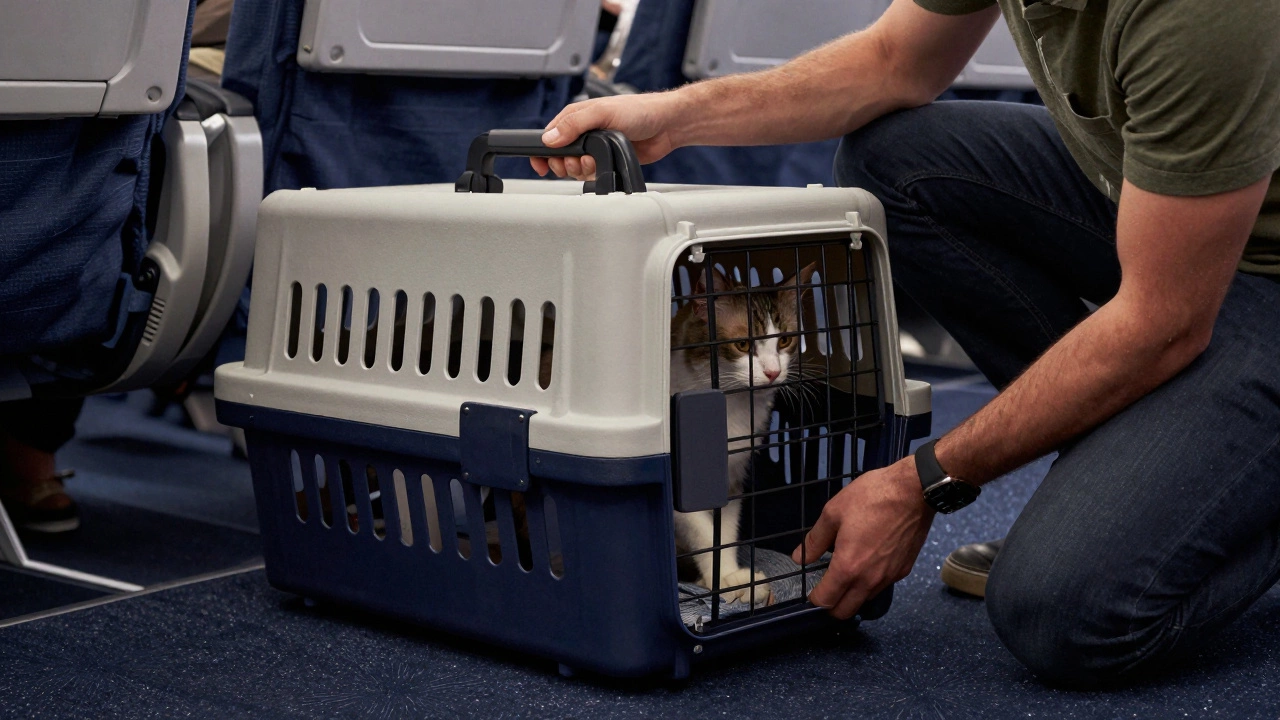
Pet Carrier Size Checker
Check Your Carrier Size
Enter your pet carrier's outer dimensions to verify if it meets standard airline requirements for in-cabin travel.
Standard maximum size: 18 x 11 x 11 inches
Your Carrier
- Length:
- Width:
- Height:
Standard Limit
- Length: 18 inches
- Width: 11 inches
- Height: 11 inches
Accepted by:
- Delta, United, American, Southwest
- JetBlue (up to 19 x 13 x 9 inches)
- Lufthansa (55 x 40 x 23 cm)
Note: Dimensions must be measured from the outer edges of the carrier. Soft-sided carriers have more flexibility than hard-shell carriers.
If you’re planning to fly with your dog or cat, the first thing you need to know is this: airlines don’t all allow the same size pet carrier. There’s no universal rule. What one airline calls "maximum size," another might reject as too big. And if you show up at the gate with a carrier that looks right to you but doesn’t meet their exact specs, you could be forced to check your pet-or worse, miss your flight.
What airlines actually allow as the largest pet carrier
Most major U.S. airlines-like Delta, United, American, and Southwest-set their maximum carry-on pet carrier size at 18 x 11 x 11 inches. That’s about the size of a standard carry-on suitcase, but shaped to fit under the seat in front of you. This is the biggest size you’ll commonly find approved across multiple carriers. Some airlines, like JetBlue, are slightly more flexible and may allow up to 19 x 13 x 9 inches, but only if the carrier fits under the seat without blocking the aisle or other passengers’ space.Why these numbers? Because the space under an airplane seat isn’t very deep. Airlines design their seats with a fixed clearance-usually around 11 inches of height-and the carrier must fit snugly without being forced. If your carrier sticks out, the flight attendant will ask you to move it or check it. And once it’s checked, you’re paying extra, risking delays, and exposing your pet to cargo hold conditions you can’t control.
International airlines like Lufthansa, Air Canada, and British Airways also follow similar limits. Lufthansa allows 55 x 40 x 23 cm (about 21.5 x 15.5 x 9 inches), which is slightly taller but narrower. Air Canada sticks to 17 x 10 x 11 inches for cabin pets. So while there’s some variation, 18 x 11 x 11 inches is the safest benchmark if you’re flying domestically or to North America.
Why size matters more than weight
Many pet owners assume weight is the main factor. It’s not. Airlines care about dimensions because they’re trying to keep the cabin organized. A 20-pound dog in a soft-sided carrier that’s 17 x 10 x 10 inches? That’s fine. A 12-pound cat in a hard-shell carrier that’s 20 x 12 x 12 inches? That’s a problem-even if the pet is tiny.Carriers are measured by their outer dimensions, not the pet’s size. So even if your pet fits comfortably inside, if the carrier itself is too tall, wide, or deep, it’s not allowed. Airlines don’t measure your pet. They measure the box.
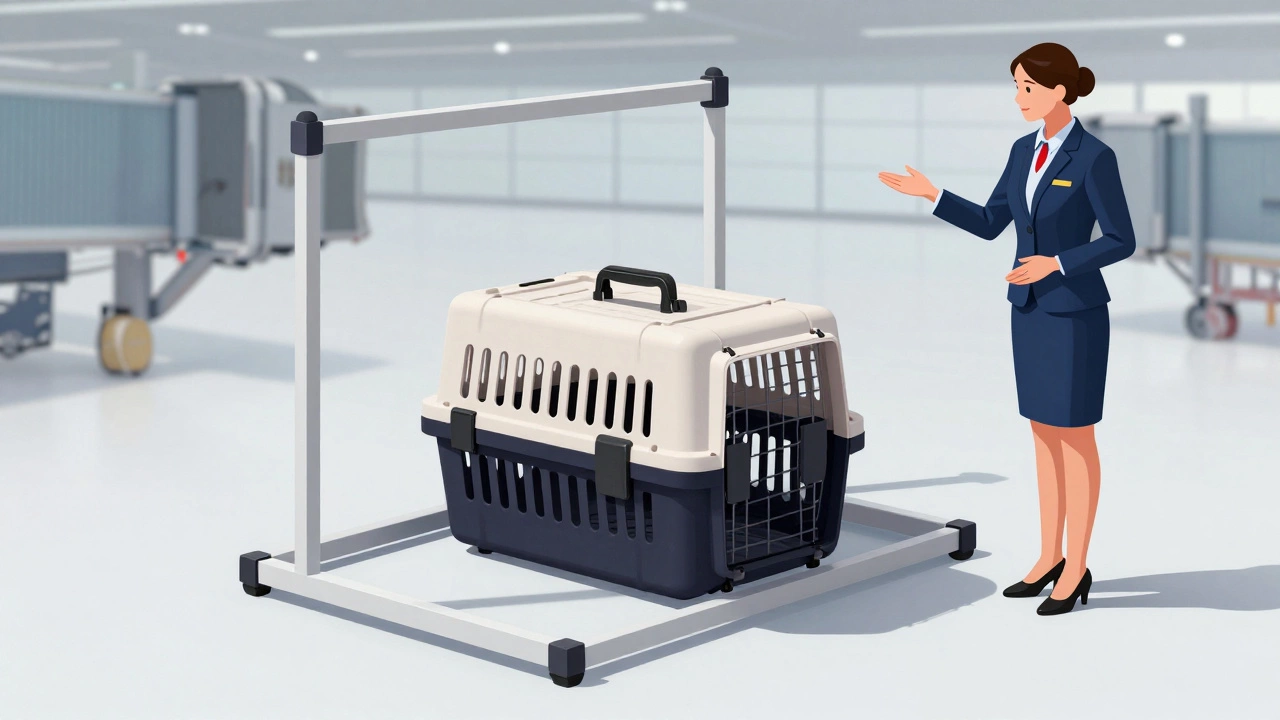
Soft-sided carriers are usually preferred because they can be squeezed into tight spaces. Hard-shell carriers are rigid and harder to adjust. If you’re close to the limit, a soft-sided carrier gives you a little more wiggle room. But don’t assume that means you can stretch it. Airlines have rigid measuring tools at the gate. If it doesn’t fit in their sizing frame, it doesn’t fly.
What happens if your carrier is too big
You might think, "I’ll just check it at the counter." But here’s the catch: if your pet carrier doesn’t meet carry-on size rules, you’re not automatically allowed to check it as luggage. Many airlines require you to book a separate cargo reservation if your pet exceeds carry-on limits-even if you’re willing to pay extra.Delta, for example, won’t let you check a pet at the gate if it’s too big for the cabin. You have to arrange cargo transport in advance through their PetSafe program. Same with United and American. You can’t just show up and say, "I’ll pay to check it." The system doesn’t work that way.
And if you’re flying internationally, some countries have strict rules about where pets can enter. If your pet is checked as cargo, you might face additional quarantine requirements, paperwork, or even denial of entry. That’s why getting the size right the first time isn’t just about convenience-it’s about avoiding legal and health risks for your pet.
What to look for in a carrier that fits
You don’t need to buy the biggest carrier possible. You need the right-sized one. Here’s what to check before you buy:- Measure the carrier’s outer dimensions-not the interior. Use a tape measure on the top, sides, and bottom.
- Make sure the carrier has a rigid bottom. Soft bottoms sag and won’t fit under the seat.
- Look for a carrier with a handle and wheels if you’re traveling long distances. It’s not required, but it helps.
- Check for ventilation on at least three sides. Airlines require this for safety.
- Ensure the door opens easily from the front or top. Some airlines won’t allow carriers with side-entry doors.
- Confirm the carrier is leak-proof and has a secure latch. No zippers alone-they’re not enough.
Popular brands like Sherpa, SturdiBag, and Petmate offer models that are designed to meet airline standards. The Sherpa Deluxe Carrier, for example, is 18 x 11 x 11 inches and has been approved by over 20 airlines. It’s not the cheapest option, but it’s the most reliable if you fly often.
How to test your carrier before you fly
Don’t wait until you’re at the airport. Test your carrier at home. Grab a ruler or tape measure and compare it to the dimensions listed on the airline’s website. Then, find a seat at a local airport (yes, you can sit in the waiting area) and try sliding the carrier under the seat. If it doesn’t slide in easily, it won’t fit on the plane.Some travelers bring their carrier to the airport a day early and ask a gate agent to check it with their sizing frame. Most will let you do this if you’re polite and explain you’re trying to avoid problems. It’s a small step that can save you hours of stress.
What about emotional support animals?
As of 2021, U.S. airlines no longer recognize emotional support animals as service animals. That means they’re treated the same as pets. If your dog is an ESA, you still need to follow the same carrier rules. No special exceptions. No free passes. No extra space. The carrier must still fit under the seat. If it doesn’t, you’ll pay the pet fee and check it-or leave it behind.What if your pet is too big for any carrier?
If your dog is over 20 pounds or too tall to fit in a 18 x 11 x 11 inch carrier, you have two real options:- Book your pet as cargo. This requires advance notice, a health certificate, and a special crate that meets IATA standards. It’s more expensive and more stressful, but it’s safe if done right.
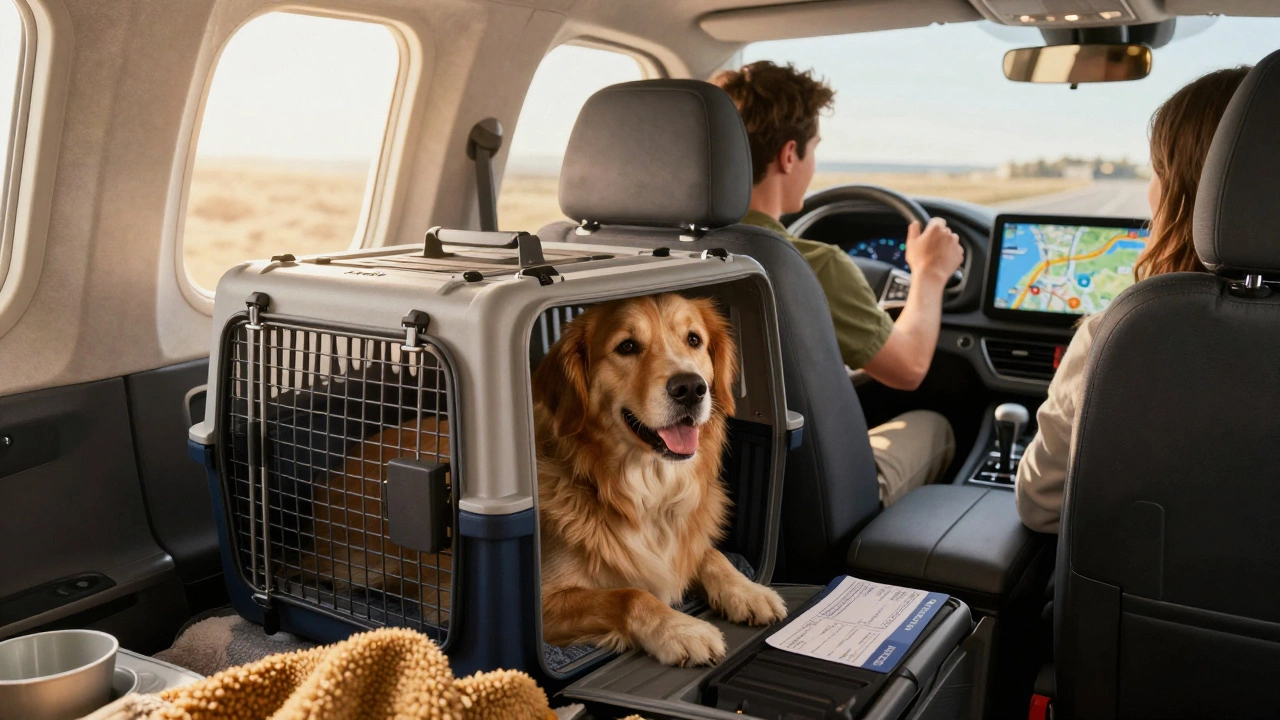
- Consider ground travel. For shorter distances, driving or using a pet transport service might be cheaper, safer, and less traumatic for your pet.
There’s no shame in choosing ground transport. Many pet owners do it. Pets are less stressed on the road. You can stop for breaks, bring their favorite blanket, and keep them with you the whole time. For trips under 8 hours, it’s often the better choice.
Final checklist before your flight
Before you leave for the airport, run through this quick list:- Confirmed airline pet policy (check their website, not just third-party blogs)
- Carrier dimensions: 18 x 11 x 11 inches or smaller
- Carrier has ventilation on three sides
- Carrier is leak-proof and has a secure latch
- Health certificate issued within 10 days of travel (required by most airlines)
- Pet’s ID tag and microchip are up to date
- Pet is calm in the carrier (practice at home for at least a week before)
Flying with a pet isn’t hard-if you plan ahead. The biggest mistake people make is assuming all airlines are the same. They’re not. The biggest carrier you can take on a plane isn’t the one that fits your pet the most. It’s the one that fits under the seat without a fight.
What is the largest pet carrier allowed on a plane?
The largest pet carrier generally allowed on a plane is 18 x 11 x 11 inches. This size fits under most airline seats and is accepted by major carriers like Delta, United, American, and Southwest. Always confirm with your specific airline, as some may allow slightly different dimensions.
Can I use a hard-shell carrier on a plane?
Yes, but only if it meets the airline’s size limits. Hard-shell carriers are harder to adjust under the seat, so they’re riskier if you’re close to the size limit. Soft-sided carriers are preferred because they can compress slightly to fit better. Always measure the outer dimensions before buying.
Do airlines measure pet carriers at the gate?
Yes. Most airlines use a rigid sizing frame at the gate to check carrier dimensions. If your carrier doesn’t fit in the frame, you’ll be asked to check it or leave it behind. Don’t assume your carrier is fine just because it looks small-measure it before you go.
Can I bring two pets in one carrier?
No. Most airlines allow only one pet per carrier, and the carrier must be large enough for that single pet to stand, turn, and lie down comfortably. Even if the pets are small, sharing a carrier is not permitted for safety and hygiene reasons.
What if my pet is too big for a carry-on carrier?
If your pet is too large for a carry-on carrier, you must book them as cargo through the airline’s pet transport service. This requires advance notice, a health certificate, and an IATA-approved crate. Ground travel may be a better option for shorter trips.