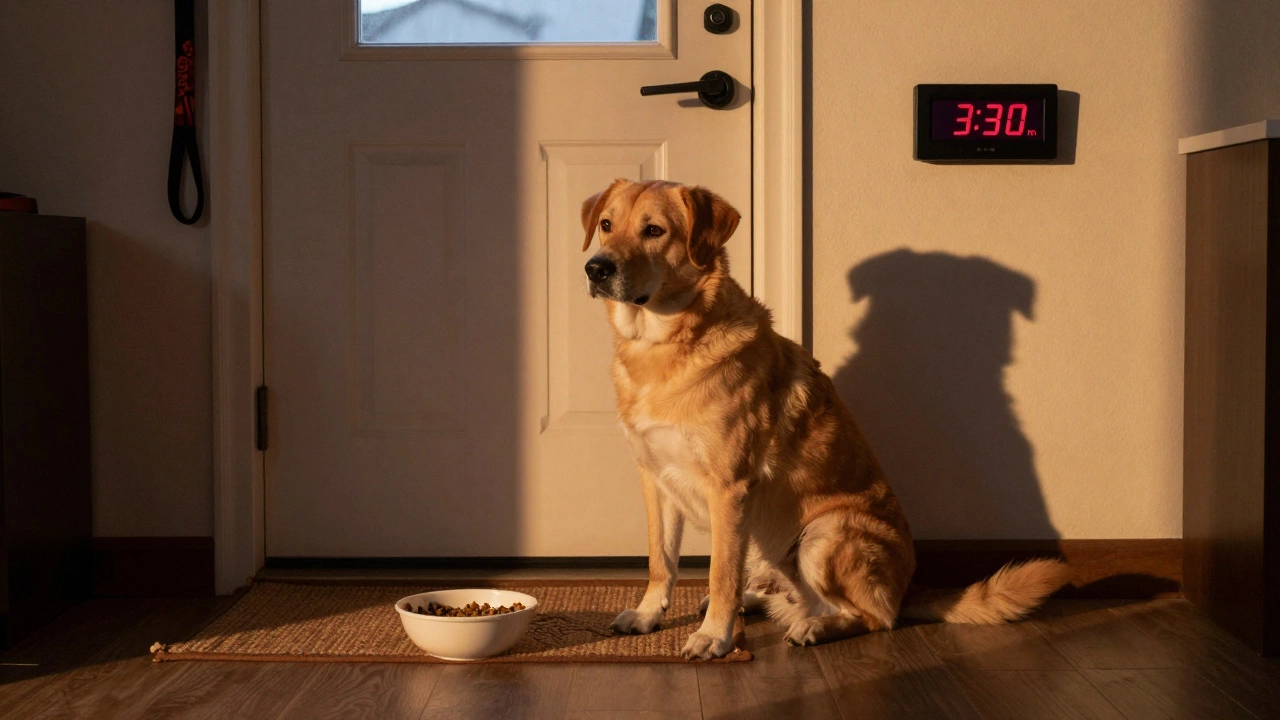
Most dog owners wonder: how long after eating does a dog poop? It’s not just curiosity-it’s practical. If your dog hasn’t gone in hours, you start to worry. If they’re going right after every meal, you wonder if something’s off. The truth? There’s no single answer, but there’s a clear pattern most dogs follow.
Most dogs poop 8 to 12 hours after eating
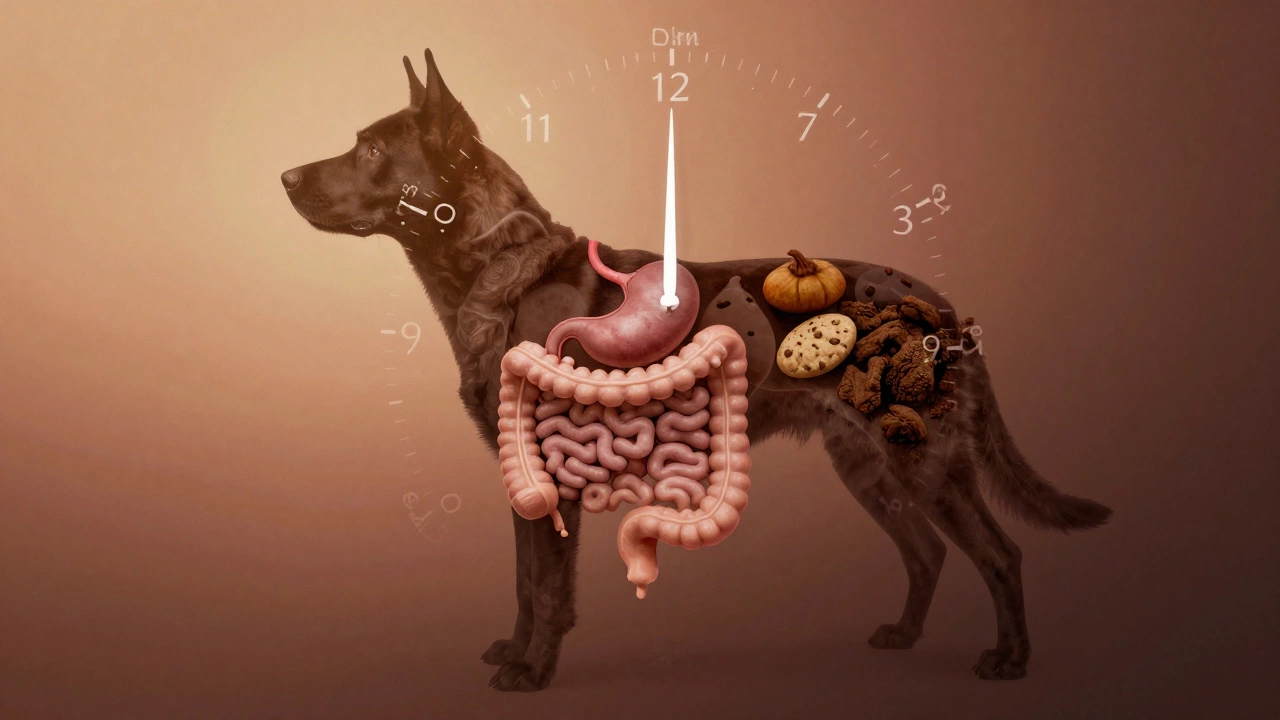
The average dog takes between 8 and 12 hours to fully digest food and pass it as waste. That means if your dog eats breakfast at 7 a.m., you can usually expect a bowel movement sometime between 3 p.m. and 7 p.m. This timing works well for most house-trained dogs and fits neatly into a daily routine.
But here’s the thing: that’s just the average. Some dogs go much faster. Others take longer. Why? It depends on a mix of things-age, diet, activity level, and even breed.
Why some dogs poop within 30 minutes
If your dog poops 15 to 30 minutes after eating, don’t panic. It’s not abnormal, especially for puppies or dogs on high-fiber diets. This is called the gastrocolic reflex. When food hits the stomach, it triggers the colon to start moving things along. It’s the same thing that makes you need the bathroom after breakfast.
Puppies are especially prone to this. Their digestive systems are still learning how to regulate. A puppy eating at 8 a.m. might poop by 8:30 a.m. That’s normal. It doesn’t mean they’re sick or that their food is bad. It just means their body is efficient-and they haven’t learned to hold it yet.
Adult dogs on wet food or raw diets also tend to go faster. Wet food moves through the system quicker than dry kibble. Raw diets, which are closer to what dogs evolved to eat, digest in as little as 4 to 6 hours. That’s why many raw feeders schedule walks right after meals.
Why some dogs take 24 hours or more
On the flip side, some dogs-especially older ones or those on low-fiber kibble-can go 24 to 36 hours between poops. If your dog eats once a day and doesn’t go until the next morning, that’s not necessarily a problem.
But if your dog hasn’t pooped in over 48 hours, that’s a red flag. Constipation can be caused by dehydration, lack of exercise, swallowed hair or toys, or even thyroid issues. If your dog is straining, whining, or seems uncomfortable, check with your vet.
What your dog’s food changes
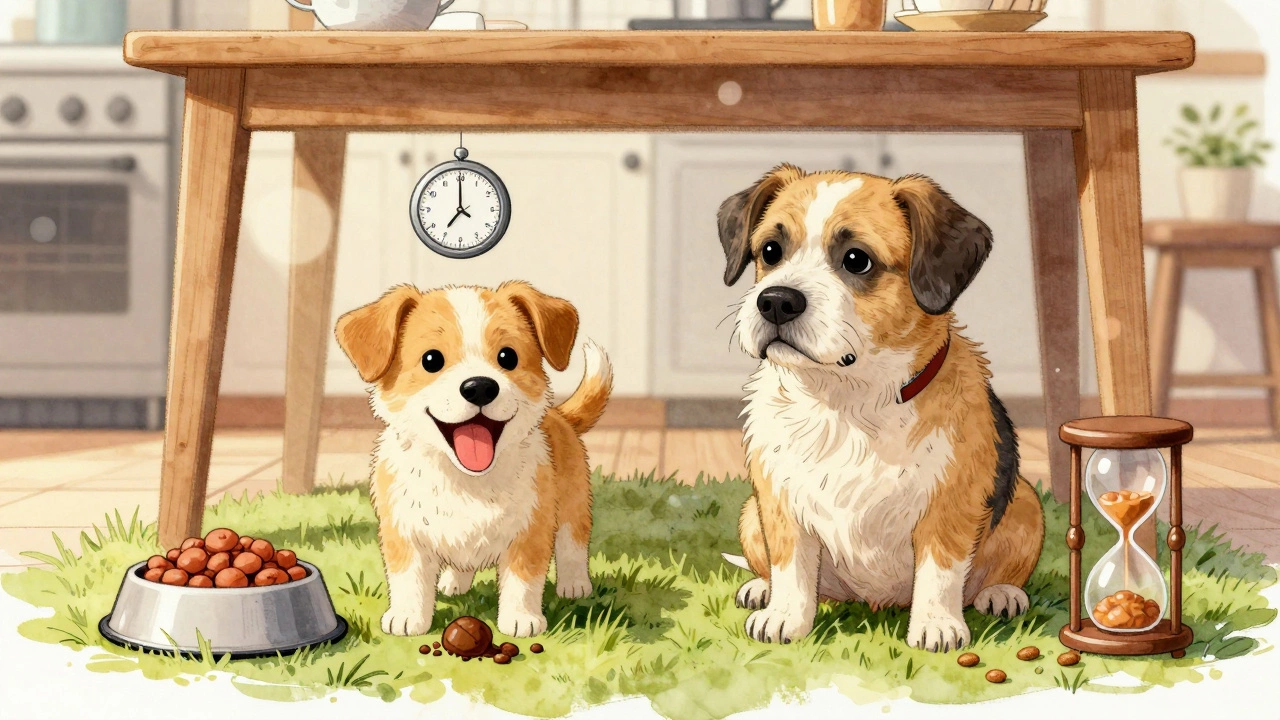
Not all dog food is created equal. The type of food you feed directly affects how fast your dog digests it and when they poop.
- High-quality kibble: Usually takes 10-12 hours to digest. Poop is firm, small, and dark brown.
- Low-quality kibble: Filled with fillers like corn or soy. Takes longer to digest, often 14-18 hours. Poop is larger, softer, and may have undigested bits.
- Wet food: Digests in 6-8 hours. Poop is softer and more frequent.
- Raw diet: Digests in 4-6 hours. Poop is smaller, firmer, and often white or chalky from bone content.
- Home-cooked meals: Varies widely. If you’re feeding rice and chicken, expect a poop in 8-10 hours. If you’re adding veggies or beans, it might be faster.
Switching foods? Give your dog 3-5 days to adjust. A sudden change can cause loose stools or constipation. Always mix old and new food gradually.
Age, breed, and activity level matter
Young dogs digest faster than older ones. A 6-month-old puppy might poop 3-4 times a day. A 10-year-old dog might go once every 24 hours. That’s normal aging.
Breed also plays a role. Small breeds like Chihuahuas and Yorkies have faster metabolisms. They eat more often and poop more often. Large breeds like Great Danes or Saint Bernards take longer to digest food and may only poop once a day.
Activity level is another big factor. A dog that runs, plays, or walks after eating will usually poop sooner. Movement stimulates the intestines. If your dog just eats and lies down, digestion slows. That’s why many trainers recommend a 15-20 minute walk after meals-not just for potty breaks, but to help digestion.
When to worry: signs of a problem
Normal dog poop is log-shaped, firm but not hard, and brown. It shouldn’t be runny, bloody, or full of mucus. Here’s when to call your vet:
- Poop is watery or diarrhea lasts more than 24 hours
- Your dog is straining, crying, or licking their rear end excessively
- Poop is black, tarry, or has bright red blood
- No poop for over 48 hours
- Poop is unusually large, greasy, or smells terrible (could mean malabsorption)
- Your dog is lethargic, vomiting, or not eating
These aren’t just "inconvenient" issues-they can signal parasites, pancreatitis, intestinal blockages, or food allergies. Don’t wait. Take a photo of the poop and call your vet.
How to train your dog to poop on schedule
If you want your dog to poop at predictable times-say, right after your morning walk or before bedtime-consistency is key.
- Feed at the same time every day. Dogs thrive on routine.
- Take them out 20-30 minutes after eating. Wait quietly. Don’t distract them with play or treats.
- Praise and reward them immediately after they go. Use a simple word like "good poop" to build the association.
- Stick to this routine for at least two weeks. Most dogs learn the pattern quickly.
Many dog owners find that after a few weeks, their dog will sit by the door at the same time every day-waiting for their cue. That’s not magic. It’s learned behavior.
What to track in a dog poop journal
Keeping a simple log helps you spot patterns. Write down:
- Time of feeding
- Time of poop
- Consistency (hard, soft, watery)
- Color (brown, yellow, black, green)
- Amount (small, medium, large)
- Any unusual signs (mucus, blood, undigested food)
After a week, you’ll start to see what’s normal for your dog. That makes it easier to catch problems early. A vet will also thank you for having this info.
Final takeaway: Know your dog’s rhythm
There’s no universal clock for when a dog poops after eating. But once you learn your dog’s pattern, you’ll know when something’s off. Most dogs poop 8-12 hours after a meal, but some go sooner, others later. What matters isn’t the exact time-it’s consistency.
If your dog’s routine changes suddenly, or their poop looks wrong, don’t ignore it. Dogs can’t tell us when something hurts. But their poop? That’s their way of speaking. Listen to it.