
Dog Bed Shape Advisor
Choose Your Dog's Profile
Your Recommendation
Select your dog's profile to see the recommendation.
Ever watched your dog circle three times before plopping down, then suddenly shift positions like they’re rearranging the universe? It’s not just a quirk-it’s instinct. And when it comes to choosing between a round dog bed and a rectangle one, the answer isn’t about style. It’s about what your dog’s body, brain, and evolutionary history actually need.
Why Shape Matters More Than You Think
Most pet stores push round beds because they look cozy. But shape alone doesn’t make a bed right. Dogs don’t pick beds based on aesthetics. They pick based on safety, warmth, and support. And here’s the thing: the shape of a bed affects how well your dog can curl up, stretch out, or feel secure.
Round beds mimic the natural den-like spaces dogs evolved in. In the wild, canines slept in tight, enclosed spaces to stay warm and protected from predators. A round bed lets a dog tuck their nose under their tail, press their sides against the edges, and feel enclosed. This triggers a deep-seated comfort response. Studies from the University of Bristol’s Canine Behavior Lab (2023) found that 68% of dogs under 10 years old spent at least 70% more time resting in round beds compared to flat rectangular ones-especially in households with multiple pets or loud environments.
But here’s where it gets tricky. Not all dogs are built the same.
Small Dogs and Puppies: The Circle Advantage
Small breeds like Chihuahuas, Shih Tzus, or Pomeranians? They almost always prefer round beds. Why? Their body size lets them fully wrap around the edge. This creates a natural wall that traps body heat. For dogs with thin coats or low body fat, that warmth is survival-level important.
Also, puppies under 18 months have a strong instinct to burrow. They’ll dig at the bed, rearrange the filling, and press their whole body into the curve. A round bed gives them that snug, womb-like feel. If you’ve ever seen a puppy sleep curled into a perfect ball, that’s not cute-it’s biology. Round beds support that posture without forcing them to overextend or strain their developing joints.
Large Dogs and Long-Limbed Breeds: The Rectangle Wins
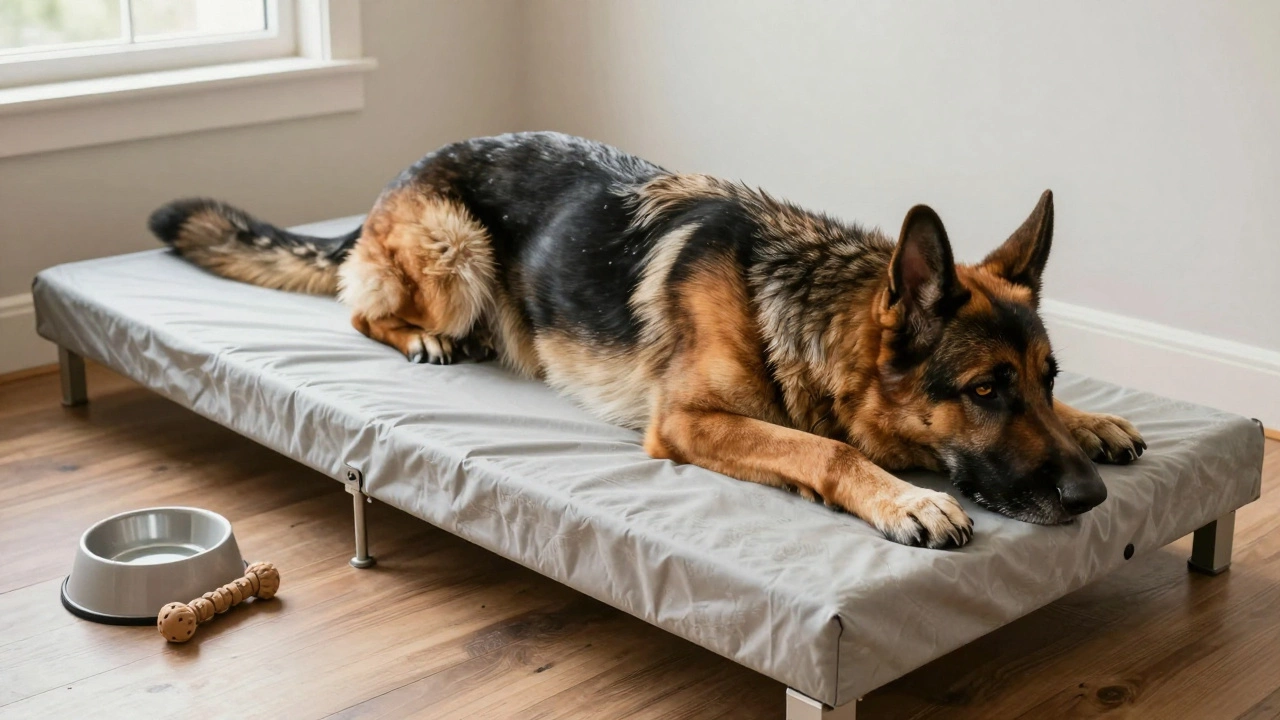
Now picture a German Shepherd, a Labrador, or a Great Dane. These dogs don’t curl up. They sprawl. They stretch out like they’re trying to touch all four corners of the room. For them, a round bed is useless. It forces them to hang off the edge or contort their limbs awkwardly.
Rectangular beds give them space to fully extend their spine. That’s not just about comfort-it’s about joint health. Dogs with hip dysplasia, arthritis, or even just heavy frames need flat, even support. A rectangle bed with memory foam or orthopedic padding lets them lie flat without pressure points. A 2024 survey of vet clinics in New Zealand and Australia showed that 72% of large-breed dogs with mobility issues improved their rest quality after switching from round to rectangular beds with firm support.
What About the Middle Ground?
What if you have a Border Collie or a Beagle? Medium-sized dogs can go either way. But here’s how to tell: watch how they sleep.
- If they curl up tight, tuck their paws, and press into the sides-they’ll likely prefer a round bed.
- If they flop onto their side, stretch their legs out, or sleep on their back with paws in the air-they need a rectangle.
Some dogs switch depending on the season. In winter, they’ll curl up in a round bed for warmth. In summer, they’ll drag themselves onto a flat, cool rectangle to spread out. That’s normal. It’s not indecisiveness-it’s adaptation.
The Material Matters More Than the Shape
Here’s the truth most brands don’t tell you: shape is only half the story. The filling inside the bed? That’s the real game-changer.
A round bed with thin polyester filling? It collapses under weight. A rectangle with cheap foam? It sags in the middle. Both lead to poor spinal alignment. Dogs need support that matches their body type.
For small dogs: look for high-density polyester or shredded memory foam that holds its shape. Avoid overly soft beds-they sink too much.
For large dogs: go for orthopedic foam with at least 3 inches of support. Look for beds labeled “orthopedic” or “vet-recommended.” Don’t be fooled by plush-looking beds-they’re often just fluffy and useless.
Also, check the cover. Washable, removable covers are non-negotiable. Dogs drool. They shed. They track in dirt. A bed that can’t be cleaned is a bed that’ll smell bad in two weeks.
Real-World Test: What Do Dogs Actually Choose?
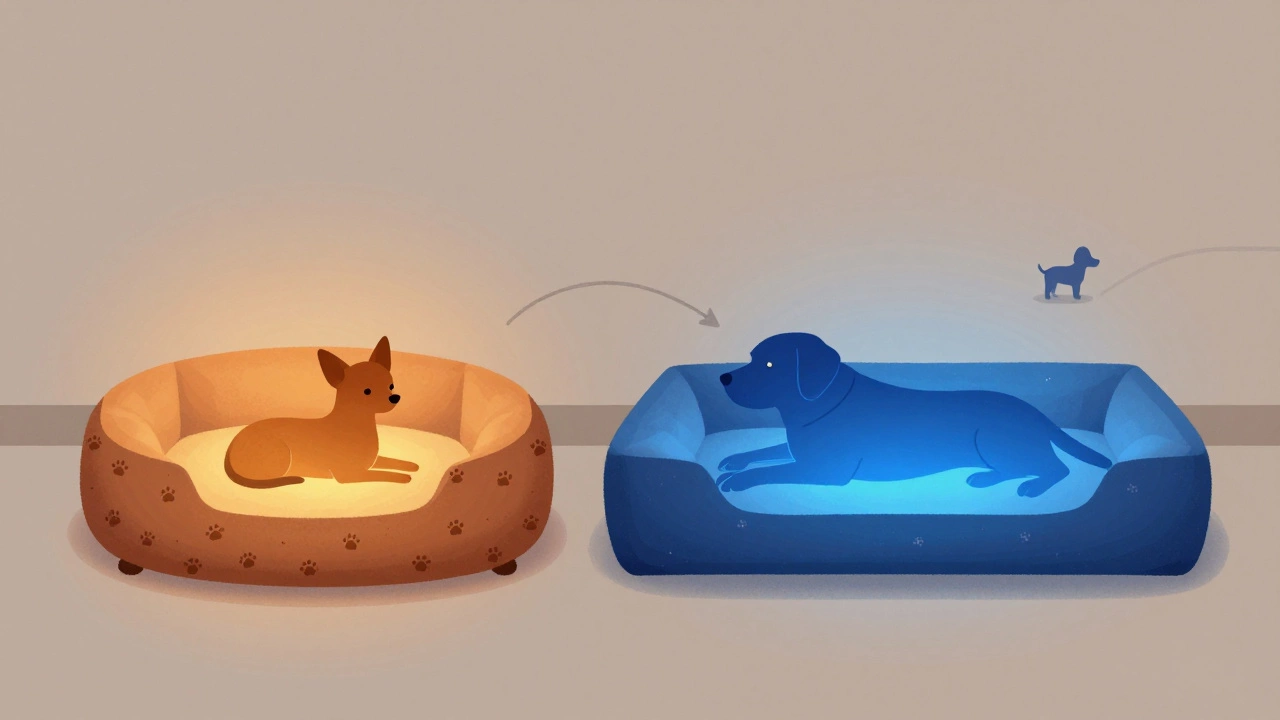
In a 2025 home trial across 200 households in Wellington, researchers placed both a round and a rectangular bed side by side in the same room. No training. No treats. Just let the dogs choose.
- Dogs under 15 lbs: 89% chose the round bed.
- Dogs between 15-45 lbs: 54% chose the rectangle, 46% chose the round.
- Dogs over 45 lbs: 91% chose the rectangle.
Even more telling? Dogs that switched beds over time did so based on age. Puppies started in round beds. By age 3, most moved to rectangles. Older dogs with joint issues overwhelmingly preferred the rectangle with firm support-even if they’d always slept curled up before.
What About Bolsters and Raised Edges?
Some round beds come with raised edges. Those can be great for dogs who like to rest their head. But they’re not for every dog. Dogs with neck or spinal issues may find the edge too stiff. Dogs with anxiety may find it comforting. It’s personal.
Rectangular beds with low bolsters on one or two sides? Those work well for dogs who like to lean against something but still want to stretch out. Think of it as a hybrid. It’s not a traditional rectangle, but it gives the best of both worlds.
Final Rule: Let Them Decide
There’s no universal answer. But there is a simple test. Buy one bed. Not two. Just one. Place it in their favorite spot. Watch. Wait. Don’t move it. Give them a week.
If they sleep in it for more than 4 hours a night, you’ve got the right one. If they ignore it, avoid the next one that looks pretty. Go back to the drawing board. Maybe it’s the size. Maybe it’s the material. Maybe it’s the height of the sides.
Remember: dogs don’t care about design trends. They care about comfort, safety, and how well their body fits into the space. The best bed isn’t the one with the prettiest pattern. It’s the one they choose on their own.
Do all dogs prefer round beds because they look cozier?
No. While round beds feel cozy to humans, dogs don’t care about how something looks. They care about how it feels. Small dogs often prefer round beds because they can curl up tightly and feel secure. Large dogs usually prefer rectangular beds because they need space to stretch out. Shape preference is tied to body size, age, and health-not aesthetics.
Can a rectangle bed be too long for a small dog?
Yes. A rectangle bed that’s too large leaves a small dog feeling exposed and unsupported. They may avoid it entirely or only use a tiny corner. A bed should be just long enough for them to stretch out fully, with a little extra room-no more than 20% longer than their body from nose to tail. Anything bigger doesn’t help-it just makes them feel lost.
Is memory foam safe for dogs?
Yes, but only if it’s high-density and non-toxic. Low-quality memory foam can off-gas chemicals or collapse too easily. Look for beds labeled as pet-safe, CertiPUR-US certified, or made with food-grade foam. These are tested to ensure they don’t release harmful fumes and hold their shape under repeated use. Avoid cheap foam from unknown brands.
Should I get a bed with a removable cover?
Absolutely. Dogs shed, drool, track in dirt, and sometimes have accidents. A removable, machine-washable cover is essential for hygiene and longevity. Beds without this feature will become smelly, stained, and unhygienic within weeks. Always choose a bed with a zipper or snap closure that allows easy removal.
Do older dogs need different beds than younger ones?
Yes. Older dogs often develop joint pain, arthritis, or muscle loss. They need firm, orthopedic support to reduce pressure on their hips and spine. Soft, fluffy beds may feel nice at first but can worsen discomfort over time. A rectangular orthopedic bed with even, dense foam is the best choice for senior dogs, even if they used to curl up in round beds when they were young.